
 (281) 655-4383
 Email Us


 For most of the year, a house in Tomball, Cypress, Spring or The Woodlands runs on electricity. The air conditioner does the heavy lifting from spring into fall, and the gas side of the house mostly sits there.
Then the first real cool front comes through. The furnace in the attic lights for the first time since late winter. Someone builds a fire or turns on the gas logs. The holidays arrive, the gas range runs all afternoon, and the house fills with family.
That shift is exactly when carbon monoxide deserves a few minutes of attention. Carbon monoxide has no color and no smell, and every gas appliance in the house can produce it when something is off. Here is what to check before the heat comes back on.
Why Does Carbon Monoxide Risk Go Up When Houston Cools Off?
Because the appliances that burn fuel start running again, often after sitting idle and unwatched for months.
A lot can happen to a gas appliance while nobody is using it. Attic furnaces get bumped during AC service calls, insulation work and cable installs, and a vent pipe that gets knocked loose will not announce itself until the burners light. Flues collect debris. Fireplaces get their first use of the season with guests in the room. And holiday cooking keeps the gas range and oven running far longer than usual.
None of this is a reason to worry. It is a reason to look.
Where Are The Gas Appliances In A Typical Nw Houston Home?
Usually in places people rarely go, which is why they get overlooked.
- The furnace is very often in the attic, sometimes in a closet or the garage.
- The water heater is commonly in the garage, sometimes in the attic or a utility closet.
- The range and oven in the kitchen.
- Gas logs or a gas fireplace in the living room.
- A gas dryer in the laundry room.
- The attached garage itself, where a running vehicle is its own source.
Knowing where each one is helps you decide where alarms belong and what to look at.
What Should You Look At On The Attic Furnace Before It Runs?
Look at the vent pipe first. It is the part that carries combustion gases out of the house, and it is the part most often disturbed.
On a cool morning, with a flashlight and good footing on the attic decking:
- Follow the vent from the top of the furnace up to the roof. Every joint should be connected and fastened, with no gaps or separations.
- Look for rust, soot or scorch marks on the vent, the furnace cabinet or the draft opening. Soot where there should not be any is a sign combustion gases are not going where they should.
- Check that insulation and stored items are not packed against the vent pipe or the furnace.
- Change the filter before the first run.
When it runs for the first time, a short dusty smell is normal. A smell that lingers, a flame that looks lazy or yellow, or any soot is a reason to shut it off and call an HVAC contractor.
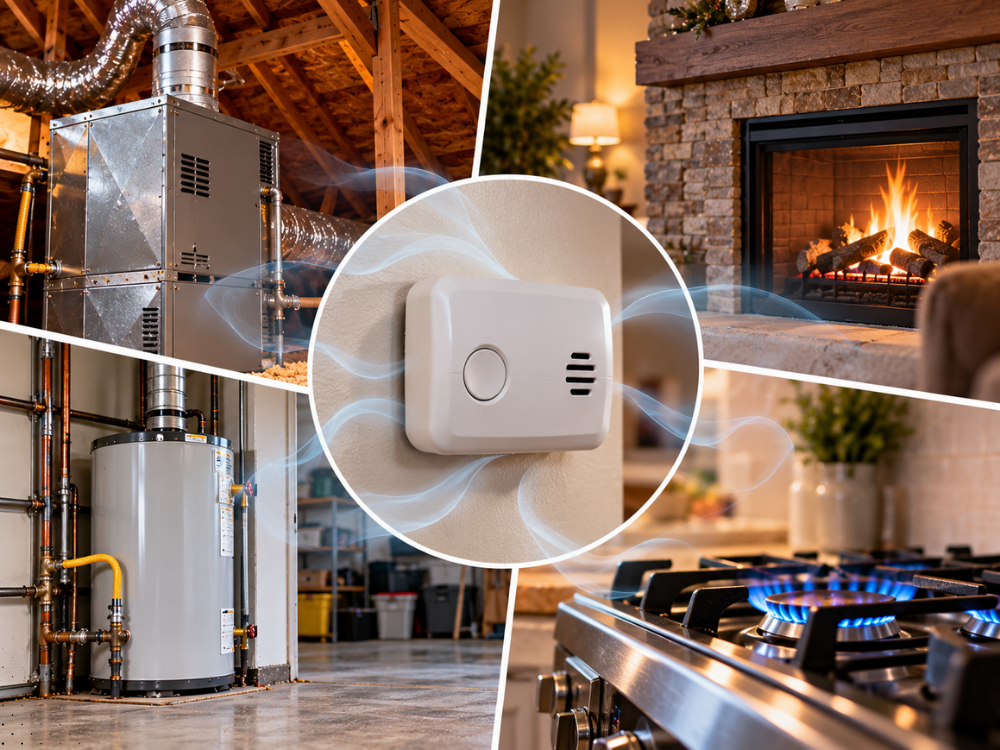 Is The Garage Water Heater Venting The Way It Should?
A gas water heater runs all year, but it is worth a look while you are checking everything else.
Confirm the vent pipe is connected at the top of the heater and runs up and out without gaps. Look for rust or soot at the draft opening. Make sure nothing is stored against the heater, and that it is protected from being hit by a vehicle. And keep gasoline, paint thinner and other flammables well away from any gas appliance in the garage.
Where Should Carbon Monoxide Alarms Go?
On every level of the home and outside each sleeping area, installed according to the alarm manufacturer’s instructions.
A few practical notes:
- Test every alarm with the test button, and replace any that fail.
- Check the date on the back. CO alarms have a limited sensor life and a replacement date printed on the unit.
- Combination smoke and CO alarms are fine, as long as they are placed where both functions work as intended.
- Guest rooms and bonus rooms over the garage need coverage too, especially with family staying over the holidays.
What About Generators And Cars In The Garage?
This is the one that matters most in a storm-prone market.
After a storm knocks out power, portable generators are a well-known cause of carbon monoxide poisoning. Never run a generator inside the house, in the garage, or on a porch close to open windows and doors — not even with the garage door open. Place it outside, well away from the house, with the exhaust pointed away from any opening.
The same goes for vehicles. Do not warm up a car in an attached garage, even with the door up.
What Should You Do If A Carbon Monoxide Alarm Goes Off?
Get everyone outside into fresh air right away, then call 911 from outside.
Do not go back in to find the source. Headache, dizziness, nausea and flu-like symptoms that ease when you leave the house are warning signs worth taking seriously. Once the emergency responders or the gas utility have cleared the house, have a qualified contractor find and fix the cause before the appliance is used again.